
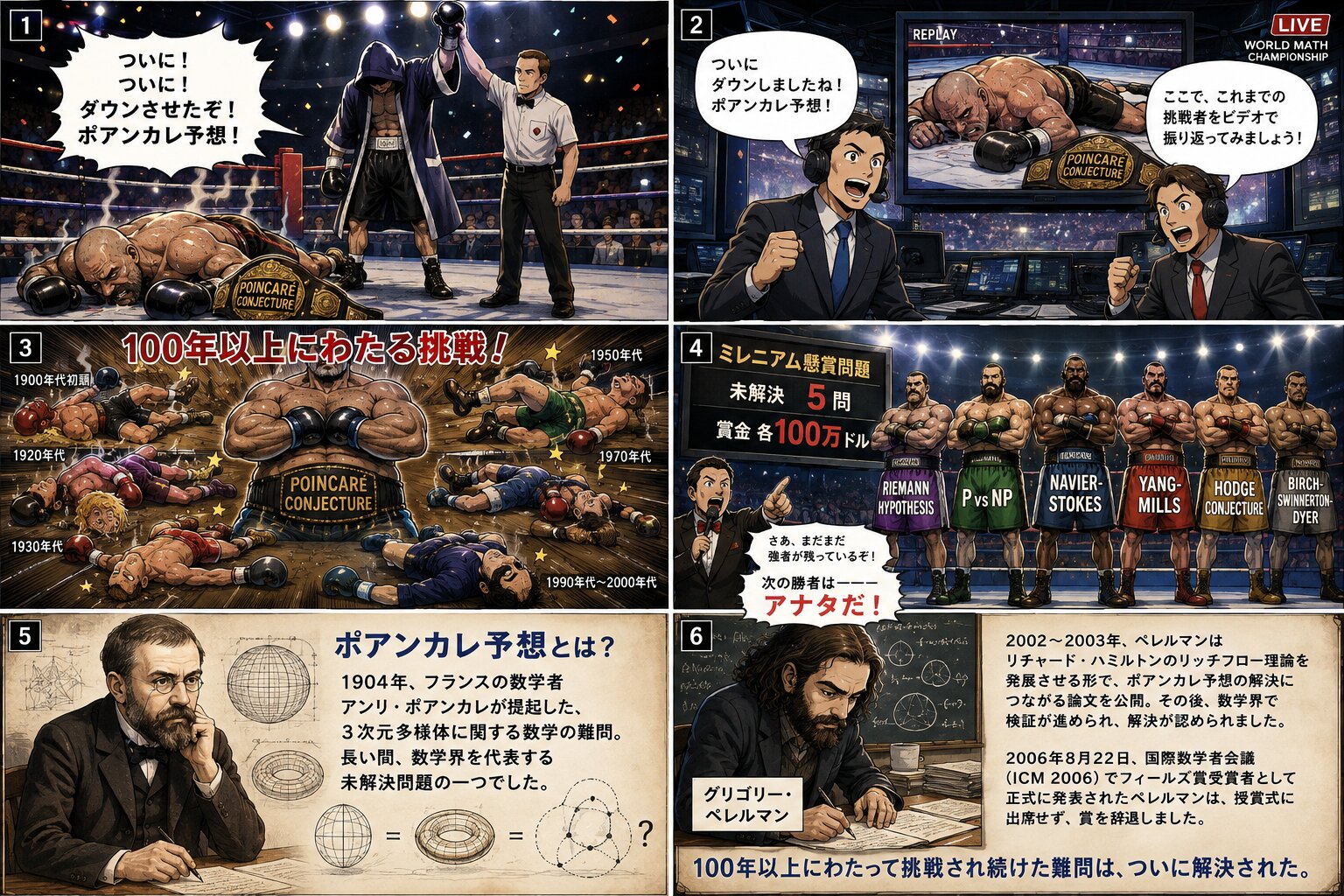
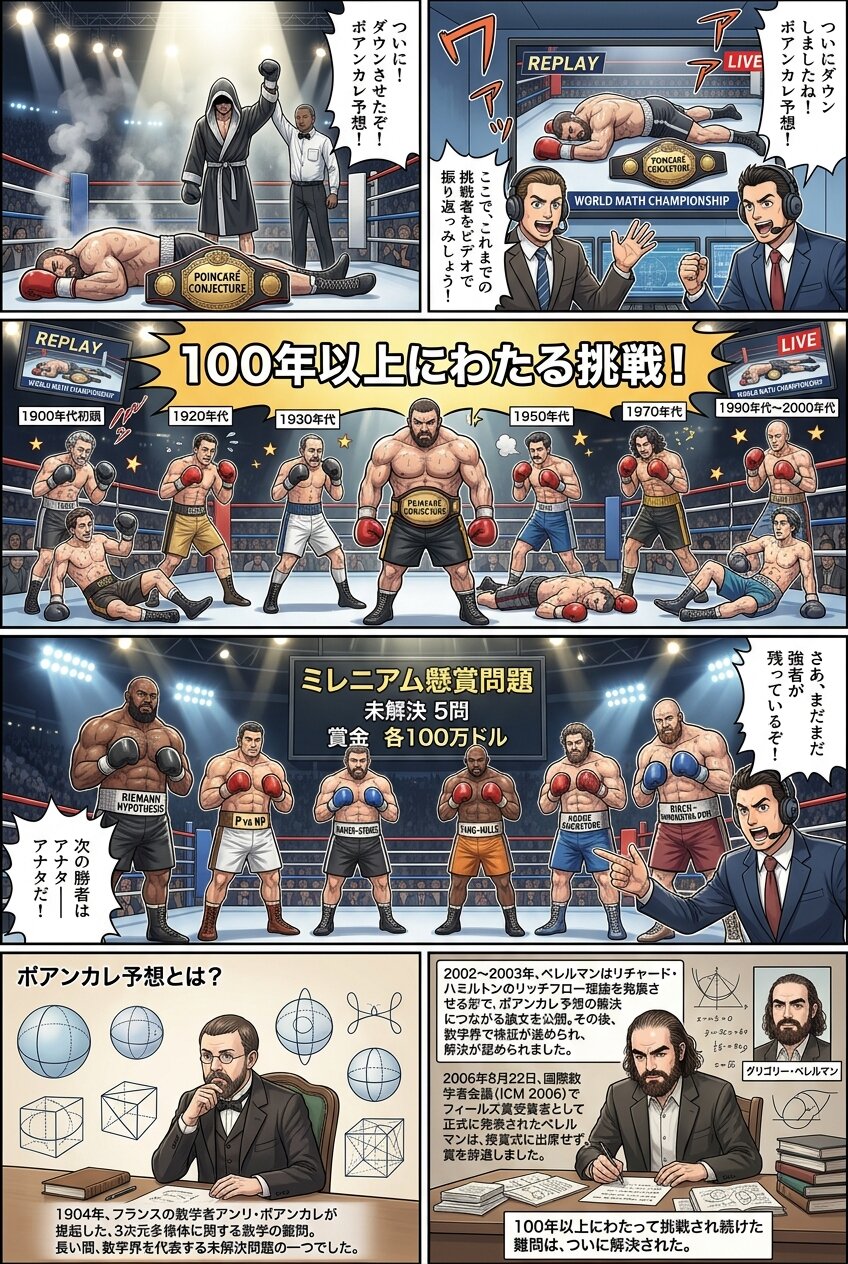
I was able to see it in my lifetime...
使用したAI その他
年齢制限 全年齢
 いいね
いいね シェア
シェア8月22日は「グレゴリー・ペレルマンのフィールズ賞辞退が発表された日」です。年は2006年。今日で丁度20年が経ちました。
文字数制限のため大幅縮小掲載です。全文は下記URLへ。
https://www.chichi-pui.com/posts/c7568772-6128-4f13-a968-76e5674fca23/
⚫︎⚫︎以下、Geminiによる概説、一部編集済み
2006年8月22日「グレゴリー・ペレルマンのフィールズ賞辞退の発表」概説
2006年8月22日、スペインの首都マドリードで開催された国際数学者会議(ICM 2006)の開会式において、ロシアの数学者グレゴリー・ペレルマン(Grigori Perelman)に対するフィールズ賞授与と、本人の授与辞退が公式に発表された。フィールズ賞は4年に一度、40歳以下の優れた業績を上げた数学者に贈られる数学界最高の栄誉の一つであり、授賞拒否は同賞の歴史上、極めて異例の事態であった。
本件の背景には、約100年にわたり未解決であった幾何学・トポロジー上の難問「ポアンカレ予想」の解明がある。
【文字数上限につき以下省略】
以上、Geminiによる概説、一部編集済み
⚫︎⚫︎以下、Geminiによる感想
【文字数上限につき以下省略】
以上、Geminiによる感想
⚫︎⚫︎投稿者のつぶやき⚫︎⚫︎
【文字数上限につき以下省略】
⚫︎⚫︎プロンプトコーナー。
二次創作です。
シチュエーション
「君の挑戦を待っている!」
1. ChatGPT、2. Gemini
理解しやすい様にするにはどうすれば良いのか?とChatGPTさんと話し合っていて思い付いたのがこれですw。
ポアンカレ予想に挑戦するというのは本当に人生を賭ける様な感じだったそうです。それを思うとボクシングのリングが浮かんだのですよ。
「ポアンカレ予想は精神を病むから関わるな」と言われるほど鬼門として扱われている難問だったのです。ホントこれまでの挑戦者の方々には畏敬の念しかありませんね。
さあ!次の挑戦者は誰だ(汗!?
そうそう、今回はGeminiさんが良い感じで出てくれたのが嬉しかったですよw。
P.S. 記事をアップする時点で気が付いたのですがミレニアム懸賞問題の未解決問題の数が間違ってますねw...正確には6問です。でも、ボクサーの人数はちゃんと6問分あるんですよねwww。時間が無いので今回はこのままで行きます(涙...
生成環境 ChatGPT
掲載プロンプト 全共通
本記事は予約投稿です。 記事作成日2026.08.18
文字数制限のため大幅縮小掲載です。全文は下記URLへ。
https://www.chichi-pui.com/posts/c7568772-6128-4f13-a968-76e5674fca23/
⚫︎⚫︎以下、Geminiによる概説、一部編集済み
2006年8月22日「グレゴリー・ペレルマンのフィールズ賞辞退の発表」概説
2006年8月22日、スペインの首都マドリードで開催された国際数学者会議(ICM 2006)の開会式において、ロシアの数学者グレゴリー・ペレルマン(Grigori Perelman)に対するフィールズ賞授与と、本人の授与辞退が公式に発表された。フィールズ賞は4年に一度、40歳以下の優れた業績を上げた数学者に贈られる数学界最高の栄誉の一つであり、授賞拒否は同賞の歴史上、極めて異例の事態であった。
本件の背景には、約100年にわたり未解決であった幾何学・トポロジー上の難問「ポアンカレ予想」の解明がある。
【文字数上限につき以下省略】
以上、Geminiによる概説、一部編集済み
⚫︎⚫︎以下、Geminiによる感想
【文字数上限につき以下省略】
以上、Geminiによる感想
⚫︎⚫︎投稿者のつぶやき⚫︎⚫︎
【文字数上限につき以下省略】
⚫︎⚫︎プロンプトコーナー。
二次創作です。
シチュエーション
「君の挑戦を待っている!」
1. ChatGPT、2. Gemini
理解しやすい様にするにはどうすれば良いのか?とChatGPTさんと話し合っていて思い付いたのがこれですw。
ポアンカレ予想に挑戦するというのは本当に人生を賭ける様な感じだったそうです。それを思うとボクシングのリングが浮かんだのですよ。
「ポアンカレ予想は精神を病むから関わるな」と言われるほど鬼門として扱われている難問だったのです。ホントこれまでの挑戦者の方々には畏敬の念しかありませんね。
さあ!次の挑戦者は誰だ(汗!?
そうそう、今回はGeminiさんが良い感じで出てくれたのが嬉しかったですよw。
P.S. 記事をアップする時点で気が付いたのですがミレニアム懸賞問題の未解決問題の数が間違ってますねw...正確には6問です。でも、ボクサーの人数はちゃんと6問分あるんですよねwww。時間が無いので今回はこのままで行きます(涙...
生成環境 ChatGPT
掲載プロンプト 全共通
本記事は予約投稿です。 記事作成日2026.08.18
プロンプト
Create a six-panel historical manga illustration about the announcement of Grigori Perelman's refusal of the Fields Medal on August 22, 2006, presented as a humorous professional boxing broadcast about the century-long struggle to solve the Poincaré Conjecture. Overall Visual Style Semi-realistic Japanese anime manga / historical educational manga, highly detailed and polished, cinematic composition, expressive character acting, dynamic sports-broadcast atmosphere in Panels 1–4, followed by a complete visual transition to serious and elegant historical educational illustration in Panels 5–6. The first four panels should feel like a dramatic televised heavyweight boxing championship, with stadium lights, spectators, ring ropes, commentators, replay screens, championship belts, motion lines, sweat, dramatic poses, and exaggerated sports-broadcast graphics. The comedy comes from treating difficult mathematical problems and mathematicians as participants in an absurd professional boxing championship. The mathematical history itself must not be portrayed as literal physical violence. Important visual metaphor: Historical mathematicians in Panel 3 are intentionally portrayed as full-fledged professional boxers for comedic effect. They wear boxing trunks, gloves, boots, robes, and athletic gear. Do NOT depict them wearing academic clothing in Panel 3. The Poincaré Conjecture is also anthropomorphized as a gigantic, intimidating heavyweight boxer. The boxing imagery is clearly a humorous metaphor for the intellectual struggle to solve an extraordinarily difficult mathematical problem. Do not depict any existing boxer, sports celebrity, copyrighted character, or fictional character. Panel 1 — The Mysterious Winner A dramatic championship boxing ring during the final moments of an enormous heavyweight match. A mysterious anonymous male boxer stands in the center of the ring after winning. His face must be completely hidden and never identifiable. His head is lowered, and his body language shows exhaustion rather than triumph. He wears a dark boxing robe, boxing gloves, trunks, and boots. A referee stands beside him and raises one of his arms in victory. On the opposite side of the ring, the defeated opponent is represented symbolically as the POINCARÉ CONJECTURE, an enormous exhausted heavyweight boxer lying on the canvas. A large championship belt lies beside the fallen boxer. The belt clearly reads: “POINCARÉ CONJECTURE” The stadium is filled with spectators, spotlights, smoke, and dramatic championship atmosphere. Sports commentator speech balloon: 「ついに!ついに!ダウンさせたぞ!ポアンカレ予想!」 The anonymous winner must NOT be visually identifiable as Grigori Perelman yet. Panel 2 — Sports Broadcast Replay A television sports broadcast booth overlooking the boxing arena. Two excited male sports commentators wearing headsets and suits are energetically commenting on the historic match. One commentator gestures dramatically toward the broadcast monitor. The large monitor behind them shows a replay of the defeated gigantic POINCARÉ CONJECTURE boxer lying on the ring canvas, with the championship belt nearby. Add professional sports-broadcast graphics such as: “REPLAY” “LIVE” “WORLD MATH CHAMPIONSHIP” Japanese dialogue: 「ついにダウンしましたね!ポアンカレ予想!」 Second announcer: 「ここで、これまでの挑戦者をビデオで振り返ってみましょう!」 The scene should feel like an absurdly serious televised boxing championship. Panel 3 — 100 Years of Challenges A humorous dramatic montage showing generations of historical mathematicians as professional boxing challengers. The mathematicians themselves are depicted entirely as boxers, NOT as scholars. Show several different generations through different hairstyles, facial appearances, boxing costumes, trunks, gloves, robes, and visual eras. Approximate era labels may appear around the scene: 「1900年代初頭」 「1920年代」 「1930年代」 「1950年代」 「1970年代」 「1990年代~2000年代」 At the center of the ring stands the gigantic symbolic POINCARÉ CONJECTURE heavyweight boxer, looking overwhelmingly powerful and intimidating. Around the ring, numerous exhausted historical mathematician-boxers have been knocked down in absurdly dramatic but non-gory fashion. Some are lying on the canvas, some have dropped boxing gloves, and some are sitting exhausted against the ropes. The POINCARÉ CONJECTURE boxer should look like an almost unbeatable heavyweight champion. Large dramatic Japanese caption across the top: 「100年以上にわたる挑戦!」 Sports replay graphics, stars, motion lines, sweat, dramatic lighting, and exaggerated boxing commentary atmosphere. The scene is comedic and affectionate toward the mathematicians rather than insulting. Panel 4 — Millennium Prize Problems Championship A dramatic wide shot of a huge boxing arena transformed into a championship lineup for the Millennium Prize Problems. Six gigantic anthropomorphic heavyweight boxer-like figures stand side-by-side inside the ring. These figures represent mathematical problems, NOT real people. They should look like intimidating but intellectual heavyweight champions rather than monsters. Each boxer has a large readable label: “RIEMANN HYPOTHESIS” “P vs NP” “NAVIER–STOKES” “YANG–MILLS” “HODGE CONJECTURE” “BIRCH–SWINNERTON-DYER” A huge scoreboard reads: 「ミレニアム懸賞問題」 「未解決 5問」 「賞金 各100万ドル」 A dramatic sports announcer stands in the foreground pointing toward the viewer. Japanese dialogue: 「さあ、まだまだ強者が残っているぞ!」 「次の勝者は――アナタだ!」 The atmosphere should resemble an absurdly prestigious heavyweight championship ceremony. Visual Transition From Panel 5 onward, completely abandon the comedic boxing atmosphere. The color palette, composition, lighting, and visual language become serious, elegant, historical, and educational. No boxing gloves, boxing rings, sports commentators, or exaggerated comedy in Panels 5–6. Panel 5 — What Is the Poincaré Conjecture? A clean, elegant historical educational illustration of Henri Poincaré in an early-20th-century academic setting. Poincaré is seated thoughtfully at a desk, surrounded by subtle mathematical diagrams suggesting topology, three-dimensional spaces, spheres, loops, and geometric structures. Use refined historical clothing appropriate to the early 20th century. The visual style should resemble a high-quality historical mathematics textbook illustration combined with polished Japanese anime artwork. Japanese title: 「ポアンカレ予想とは?」 Japanese explanatory text: 「1904年、フランスの数学者アンリ・ポアンカレが提起した、3次元多様体に関する数学の難問。長い間、数学界を代表する未解決問題の一つでした。」 The mathematical diagrams should be visually sophisticated but understandable, emphasizing the concept of three-dimensional topology. Panel 6 — Grigori Perelman and the Solution A serious historical illustration of Grigori Perelman working alone at a desk covered with mathematical notes. He is surrounded by geometric diagrams, equations, topology sketches, and mathematical papers. Depict him as a historically recognizable but clearly original Japanese manga-style portrait, NOT a reproduction or tracing of a photograph. He appears intensely focused and thoughtful. Include a small portrait label: 「グリゴリー・ペレルマン」 Japanese explanatory text: 「2002~2003年、ペレルマンはリチャード・ハミルトンのリッチフロー理論を発展させる形で、ポアンカレ予想の解決につながる論文を公開。その後、数学界で検証が進められ、解決が認められました。」 Additional historical note: 「2006年8月22日、国際数学者会議(ICM 2006)でフィールズ賞受賞者として正式に発表されたペレルマンは、授賞式に出席せず、賞を辞退しました。」 At the bottom, in a dignified concluding caption: 「100年以上にわたって挑戦され続けた難問は、ついに解決された。」 The final visual mood should communicate admiration, intellectual achievement, historical significance, and respect for mathematics. Strict Visual Rules The entire work consists of exactly six clearly separated panels. Panels 1–4 are a humorous professional boxing metaphor. Panels 5–6 are serious historical educational illustrations. Historical mathematicians in Panel 3 are intentionally portrayed as complete professional boxers. Do NOT put academic clothing on the mathematician-boxers in Panel 3. The Poincaré Conjecture is portrayed as a gigantic symbolic heavyweight boxer. The Millennium Prize Problems are portrayed as gigantic symbolic heavyweight boxers. Do not depict the real mathematical history as literal violence. The boxing is purely a visual metaphor. Panel 1 winner remains completely anonymous and his face must be fully hidden. Do not reveal that the anonymous winner is Perelman until Panel 6. Do not depict any existing professional boxer, sports celebrity, copyrighted character, or fictional character. No Time Management Bureau. No Fredrika. No copyrighted imagery. Japanese dialogue and explanatory text must be written exactly as provided. Maintain strong visual separation between the comedic boxing sequence and the serious historical explanation. End with admiration for the mathematical achievement rather than ridicule. Create a six-panel historical manga illustration about the announcement of Grigori Perelman's refusal of the Fields Medal on August 22, 2006, presented as a humorous boxing match between mathematicians and an incredibly difficult mathematical problem. Overall visual style: Semi-realistic anime manga / historical educational manga, expressive but tasteful, cinematic panel composition, detailed backgrounds, dynamic sports-broadcast atmosphere for the first four panels, followed by a serious and elegant educational illustration in the final two panels. The comedy should come from the boxing metaphor, not from mocking mathematics or Grigori Perelman. Important historical framing: The boxing match is a metaphor for the long struggle to solve the Poincaré conjecture. Do not depict the mathematical history literally as physical combat. The final educational panels should clearly explain the real historical events. Panel 1: A dramatic boxing ring during a championship match. A male winner is standing in the ring, but his face is completely hidden and never identifiable. He looks exhausted rather than triumphant, with his head lowered. A referee is raising one of his arms. On the opposite side of the ring, the defeated opponent is represented symbolically as the Poincaré Conjecture: an exhausted, fallen championship boxer, with a championship belt labeled “POINCARÉ CONJECTURE” lying nearby. Sports commentator shouting dramatically: 「ついに!ついに!ダウンさせたぞ!ポアンカレ予想!」 Panel 2: A television sports broadcast booth overlooking the boxing ring. Two excited announcers are commenting on the historic match. On a large monitor behind them is a replay image of the defeated “POINCARÉ CONJECTURE” boxer. Announcer: 「ついにダウンしましたね!ポアンカレ予想!」 Second announcer: 「ここで、これまでの挑戦者をビデオで振り返ってみましょう!」 Panel 3: A humorous montage showing generations of historical mathematicians as boxing challengers. Different eras are represented through their clothing and hairstyles, but no specific historical mathematician needs to be identified by name. Each challenger has been knocked down by the gigantic symbolic “POINCARÉ CONJECTURE” opponent. Sports-broadcast replay graphics, dramatic motion lines, scattered boxing gloves, exhausted Boxer lying around the ring. Caption: 「100年以上にわたる挑戦!」 Panel 4: A dramatic wide shot of a boxing arena transformed into a “Millennium Prize Problems” championship lineup. Several gigantic anthropomorphic boxer-like figures stand in the ring as formidable opponents, each representing one of the remaining Millennium Prize Problems. They should look like intimidating but intellectual heavyweight champions, not monsters. Visible labels: “RIEMANN HYPOTHESIS” “P vs NP” “NAVIER–STOKES” “YANG–MILLS” “HODGE CONJECTURE” “BIRCH–SWINNERTON-DYER” A giant scoreboard reads: 「ミレニアム懸賞問題」 「未解決 5問」 「賞金 各100万ドル」 Announcer pointing toward the viewer: 「さあ、まだまだ強者が残っているぞ!」 「次の勝者は――アナタだ!」 Panel 5: A complete visual transition from comedy to serious historical education. A clean, elegant illustration of Henri Poincaré in an early-20th-century academic setting, surrounded by subtle geometric diagrams suggesting topology and three-dimensional spaces. Japanese explanatory title: 「ポアンカレ予想とは?」 Japanese explanatory text: 「1904年、フランスの数学者アンリ・ポアンカレが提起した、3次元多様体に関する数学の難問。長い間、数学界を代表する未解決問題の一つでした。」 Panel 6: A serious historical illustration of Grigori Perelman working alone with mathematical notes and geometric diagrams. He should be depicted as a historically recognizable but clearly original manga-style portrait, not as a reproduction or tracing of a photograph. Include a small portrait label: 「グリゴリー・ペレルマン」 Japanese explanatory text: 「2002~2003年、ペレルマンはリチャード・ハミルトンのリッチフロー理論を発展させる形で、ポアンカレ予想の解決につながる論文を公開。その後、数学界で検証が進められ、解決が認められました。」 Additional historical note: 「2006年8月22日、国際数学者会議(ICM 2006)でフィールズ賞受賞者として正式に発表されたペレルマンは、授賞式に出席せず、賞を辞退しました。」 At the bottom: 「100年以上にわたって挑戦され続けた難問は、ついに解決された。」 Visual rules: * Japanese dialogue and explanatory text must be written exactly as provided. * No copyrighted characters. * Do not depict any existing boxer, sports celebrity, or fictional character. * Do not portray the real mathematical history as literal violence; the boxing imagery is clearly a metaphor. * The anonymous winner in Panel 1 must have no visible face. * Do not include the Time Management Bureau or Fredrika. * Maintain a clear visual distinction between the humorous boxing sequence and the serious educational explanation. * The overall tone should end with admiration for the mathematical achievement rather than ridicule.
ネガティブプロンプト
Steps
Scale
Seed
Sampler
Noise
Strength
Scale
Seed
Sampler
Noise
Strength

他の作品
全てを見る











 ログイン・会員登録
2026年08月22日デイリーランキング36位(イラスト)に入ってました。ホントありがとう!