
Persistence
使用したAI その他
年齢制限 全年齢
 いいね
いいね シェア
シェア8月15日は「ヨーロッパ初の一般市民が利用出来る公共図書館が開館した日」です。年は1454年。
文字数制限のため大幅縮小掲載です。全文は下記URLへ。
https://www.chichi-pui.com/posts/32a0311f-e16b-45bc-8cba-395052bce26a/
⚫︎⚫︎以下、Geminiによる概説
1454年8月15日、イタリア北部の都市チェゼーナにおいて、領主マラテスタ・ノヴェッロ(Domenico Malatesta Novello)の庇護のもと「マラテスティアーナ図書館(Biblioteca Malatestiana)」が開館した。この出来事は、中世ヨーロッパにおいて宗教施設や君主の私邸に局限されていた書物と知識の所有形態を、自治体(市民共同体)の管理下へ移管し、一般市民への閲覧利用を開放した画期的な事例として西洋図書館史に刻まれている。
中世ヨーロッパにおける書物の収集と保管は、主に修道院や大学、あるいは限られた王公貴族の私室(スタディオーロ)で行われており、閲覧権限は厳格に制限されていた。これに対し、15世紀のルネサンス人文主義の進展に伴い、古典古代の知識を社会に広く還元する構想が萌芽した。
【文字数上限につき以下省略】
以上、Geminiによる概説
⚫︎⚫︎以下、Geminiによる感想
【文字数上限につき以下省略】
⚫︎⚫︎プロンプトコーナー。二次創作です。
シチュエーション
「とある図書館の定点観測」
1. ChatGPT、2. Gemini
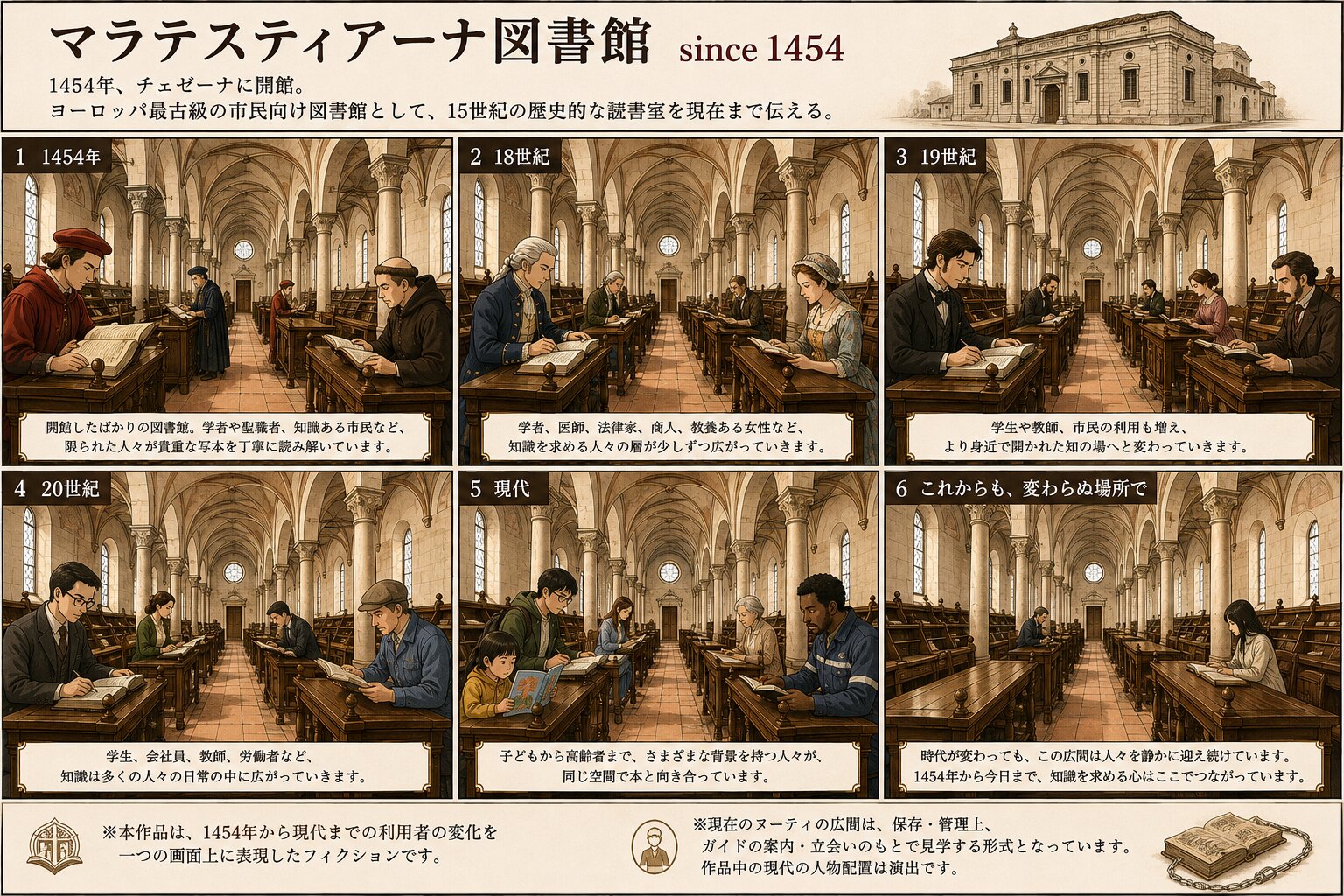
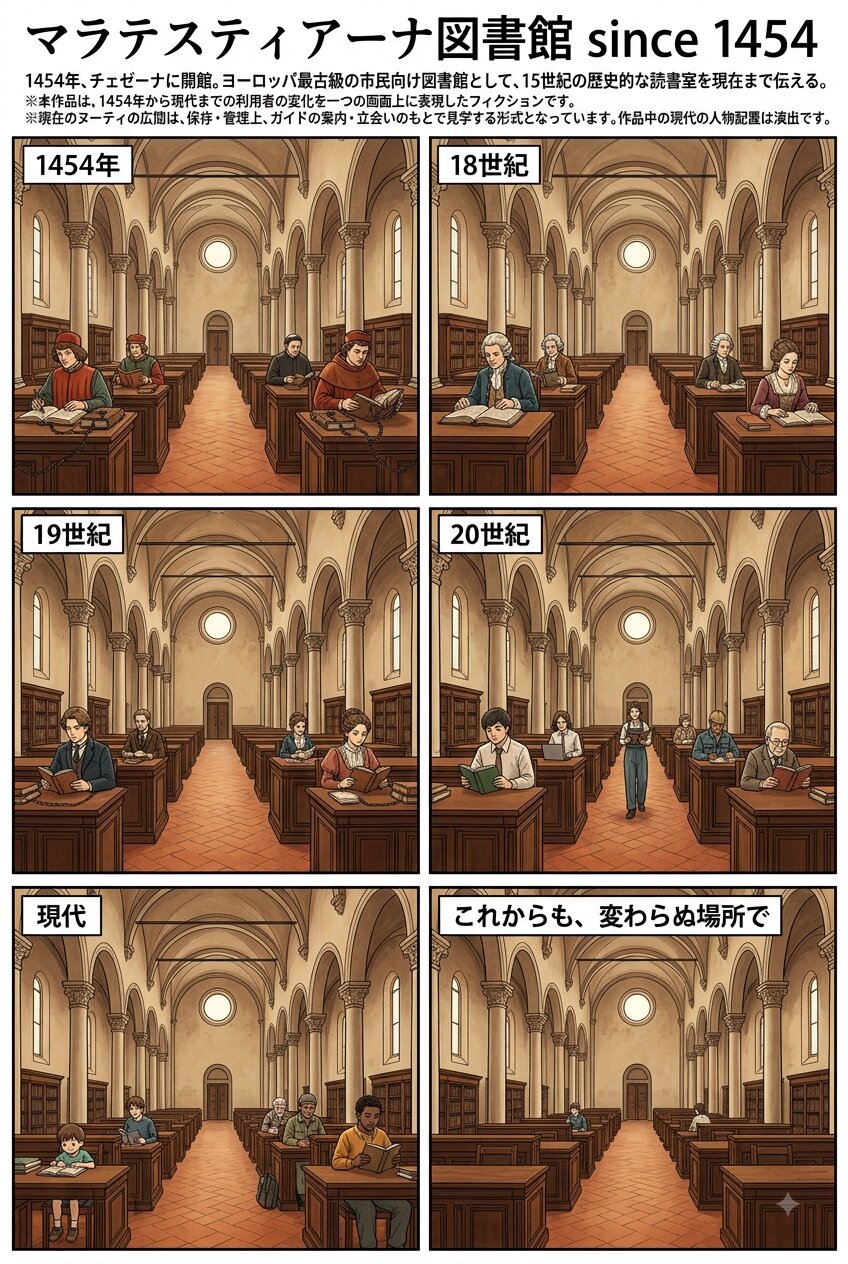
マラテスティアーナ図書館での定点観測です。内容はフィクションです。何故ならマラテスティアーナ図書館の「ヌーティの広間」の席は縦方向に向かって設置されていて横向きに向かい合った形ではないからです。一方、2枚目のGeminiさんは縦方向に席を並べてくれました。
さらに現在は広間への立ち入りにはガイドの付き添いが必ず必要な上に、実際にはイラストの様に本を読むことは禁じられているからです。ですから、少なくとも「現代」のコマの様な表現は実際には間違っています。
しかし、このイラストを見ていると「ヌーティの広間」の空間デザインの主張が強過ぎて、時代が変わってもコマの印象があまり変わらないな...というのが正直な感想ですねw。
生成環境 ChatGPT
掲載プロンプト 全共通
本記事は予約投稿です。 記事作成日2026.08.12
文字数制限のため大幅縮小掲載です。全文は下記URLへ。
https://www.chichi-pui.com/posts/32a0311f-e16b-45bc-8cba-395052bce26a/
⚫︎⚫︎以下、Geminiによる概説
1454年8月15日、イタリア北部の都市チェゼーナにおいて、領主マラテスタ・ノヴェッロ(Domenico Malatesta Novello)の庇護のもと「マラテスティアーナ図書館(Biblioteca Malatestiana)」が開館した。この出来事は、中世ヨーロッパにおいて宗教施設や君主の私邸に局限されていた書物と知識の所有形態を、自治体(市民共同体)の管理下へ移管し、一般市民への閲覧利用を開放した画期的な事例として西洋図書館史に刻まれている。
中世ヨーロッパにおける書物の収集と保管は、主に修道院や大学、あるいは限られた王公貴族の私室(スタディオーロ)で行われており、閲覧権限は厳格に制限されていた。これに対し、15世紀のルネサンス人文主義の進展に伴い、古典古代の知識を社会に広く還元する構想が萌芽した。
【文字数上限につき以下省略】
以上、Geminiによる概説
⚫︎⚫︎以下、Geminiによる感想
【文字数上限につき以下省略】
⚫︎⚫︎プロンプトコーナー。二次創作です。
シチュエーション
「とある図書館の定点観測」
1. ChatGPT、2. Gemini
マラテスティアーナ図書館での定点観測です。内容はフィクションです。何故ならマラテスティアーナ図書館の「ヌーティの広間」の席は縦方向に向かって設置されていて横向きに向かい合った形ではないからです。一方、2枚目のGeminiさんは縦方向に席を並べてくれました。
さらに現在は広間への立ち入りにはガイドの付き添いが必ず必要な上に、実際にはイラストの様に本を読むことは禁じられているからです。ですから、少なくとも「現代」のコマの様な表現は実際には間違っています。
しかし、このイラストを見ていると「ヌーティの広間」の空間デザインの主張が強過ぎて、時代が変わってもコマの印象があまり変わらないな...というのが正直な感想ですねw。
生成環境 ChatGPT
掲載プロンプト 全共通
本記事は予約投稿です。 記事作成日2026.08.12
プロンプト
Create a 6-panel historical manga / editorial illustration showing the evolution of the people using the Biblioteca Malatestiana in Cesena, Italy, from 1454 to the present day. CORE CONCEPT: The architecture is the protagonist. The SAME REAL HISTORICAL INTERIOR of the Aula Nuti (Nuti Hall) must appear in every panel. The building, camera position, perspective, columns, vaulted ceiling, arched windows, floor, wooden reading desks, and overall spatial arrangement remain essentially unchanged throughout all six panels. Only the PEOPLE change from era to era. This is a visual metaphor for approximately 570 years of changing access to knowledge. The image is NOT claiming that these exact groups of people occupied the room simultaneously or that the modern scene depicts ordinary unrestricted access. ARCHITECTURAL ACCURACY — EXTREMELY IMPORTANT: Do NOT create a generic Renaissance library. Do NOT invent a rectangular hall with a flat wooden ceiling. Do NOT use generic bookshelves along the walls. Reconstruct the recognizable interior architecture of the actual Aula Nuti of the Biblioteca Malatestiana in Cesena, Italy: a long, narrow Renaissance humanist library hall three longitudinal aisles / basilica-like three-nave plan elegant slender stone columns arranged in repeated rows rounded Renaissance arches and vaulted ceilings tall narrow arched windows along the side walls warm aged plaster and stone surfaces terracotta / stone floor dark, richly carved wooden reading desks arranged in orderly rows historic wooden book cabinets integrated with the reading desks the central aisle leading toward the far end of the hall a circular window / oculus visible at the far end original Renaissance proportions and restrained decoration the room should immediately be recognizable as the Aula Nuti of the Biblioteca Malatestiana Use a frontal or slightly elevated central perspective looking down the length of the reading hall, so the repeated columns and desks create a strong visual time-axis. The architecture must remain visually consistent from Panel 1 through Panel 6. PANEL 1 — 1454年: Approximately 3–4 people. The newly opened library in the mid-15th century. Show people who could realistically represent the educated civic / scholarly users of the period: a humanist scholar a learned civic official or merchant a cleric a manuscript reader 15th-century Italian Renaissance clothing. Rich but restrained fabrics, caps, robes, period hairstyles. They handle books carefully and read with intense concentration. Important: Do NOT portray them as generic peasants. The historical meaning of “citizen / public user” in 1454 was much narrower than the modern concept of a public library. The mood is intellectually prestigious and somewhat exclusive. PANEL 2 — 18世紀: Approximately 3–4 people. Keep exactly the same Aula Nuti architecture. Show: a scholar a physician a lawyer an educated merchant or woman from an educated household 18th-century Italian / European clothing, wigs or period hairstyles where appropriate. The atmosphere is still scholarly, but the social range of readers is beginning to broaden. PANEL 3 — 19世紀: Approximately 4 people. Same architecture. Show: a university student a teacher a young woman reading a merchant or ordinary educated citizen 19th-century clothing and hairstyles. The people should look noticeably less aristocratic and more like members of an expanding educated public. The visual message: Knowledge is becoming increasingly accessible beyond a narrow intellectual elite. PANEL 4 — 20世紀: Approximately 4–5 people. Same architecture. Show a visibly broader social mixture: a university student an office worker a teacher a worker in practical clothing an elderly reader 20th-century clothing, naturally mixed but historically coherent. The important change is not simply fashion. The SOCIAL COMPOSITION of the room is changing. Readers increasingly look like ordinary members of society rather than exclusively scholars and elites. PANEL 5 — 現代: Approximately 5 people, NO CROWD. Same exact Aula Nuti interior. Show contemporary visitors naturally sharing the historic room: a child reading a university student an elderly reader a person wearing practical work clothes a contemporary visitor of a different ethnic background Include a natural diversity of modern visitors reflecting contemporary multicultural European society. Different ages, occupations, ethnic backgrounds and clothing styles. Nobody is exoticized. Nobody is presented as a symbolic stereotype. Everyone is simply a person reading a book. The key visual idea: People who would have belonged to very different social categories in 1454 now appear together as ordinary readers. PANEL 6 — THE PASSAGE OF TIME: Same exact Aula Nuti interior. Only 2–3 modern readers remain, placed naturally in the distance. Leave enough empty space for the architecture to dominate. The room should feel timeless. The viewer should suddenly realize: THE BUILDING REMAINED. THE PEOPLE CHANGED. This final panel should have a quiet but emotionally powerful atmosphere, suggesting that generations of readers have passed through the same room. Do not make this panel sad. Make it contemplative and quietly hopeful. TITLE: At the top of the entire image: 「マラテスティアーナ図書館 since 1454」 SHORT EXPLANATION: 「1454年、チェゼーナに開館。 ヨーロッパ最古級の市民向け図書館として、15世紀の歴史的な読書室を現在まで伝える。」 Use “ヨーロッパ最古級” rather than an overly absolute modern interpretation of “公共図書館”. HISTORICAL NOTE: 「※本作品は、1454年から現代までの利用者の変化を一つの画面上に表現したフィクションです。」 CURRENT VISITATION NOTE: 「※現在のヌーティの広間は、保存・管理上、ガイドの案内・立会いのもとで見学する形式となっています。作品中の現代の人物配置は演出です。」 VISUAL STYLE: Sophisticated modern anime historical manga. Detailed editorial illustration. Realistic Renaissance architecture. Warm natural daylight. Historically informed costumes. Beautiful but restrained facial expressions. Subtle cinematic depth. Clean linework. Detailed wooden furniture and stone architecture. Slightly humorous visual contrast between eras, but never slapstick. The historical architecture should feel more important than decorative fantasy. COMPOSITION: Six clearly separated manga panels arranged in a clean 2 × 3 layout. Each panel has a small Japanese era label: 「1454年」 「18世紀」 「19世紀」 「20世紀」 「現代」 「これからも、変わらぬ場所で」 Keep panel borders clean and consistent. MOST IMPORTANT GENERATION RULE: The background must NOT change between panels. Same: columns arches vaulted ceiling windows wooden reading desks central aisle far-end circular window floor architectural proportions camera angle perspective Only the human occupants and their historical appearance change. NEGATIVE PROMPT: generic medieval library, generic Renaissance library, flat wooden ceiling, modern library interior, fantasy architecture, Gothic cathedral interior, huge bookshelves, changing architecture between panels, different camera angles, crowded library, large crowd, more than 5 people in a panel, duplicated characters, merged bodies, extra limbs, malformed hands, distorted books, floating books, modern furniture in historical panels, historically inaccurate architecture, exaggerated medieval costumes, fantasy costumes, theatrical costumes, people posing for the camera, people looking directly at viewer, excessive text, unreadable text, overly dramatic action, slapstick comedy. The final image must communicate one simple idea: 「同じ場所で、知識を求める人々だけが、570年かけて変わっていった。」
ネガティブプロンプト
Steps
Scale
Seed
Sampler
Noise
Strength
Scale
Seed
Sampler
Noise
Strength

他の作品
全てを見る

 ログイン・会員登録
2026年08月15日デイリーランキング27位(イラスト)に入ってました。これがランクインしてるだなんて...ありがとう(涙!