
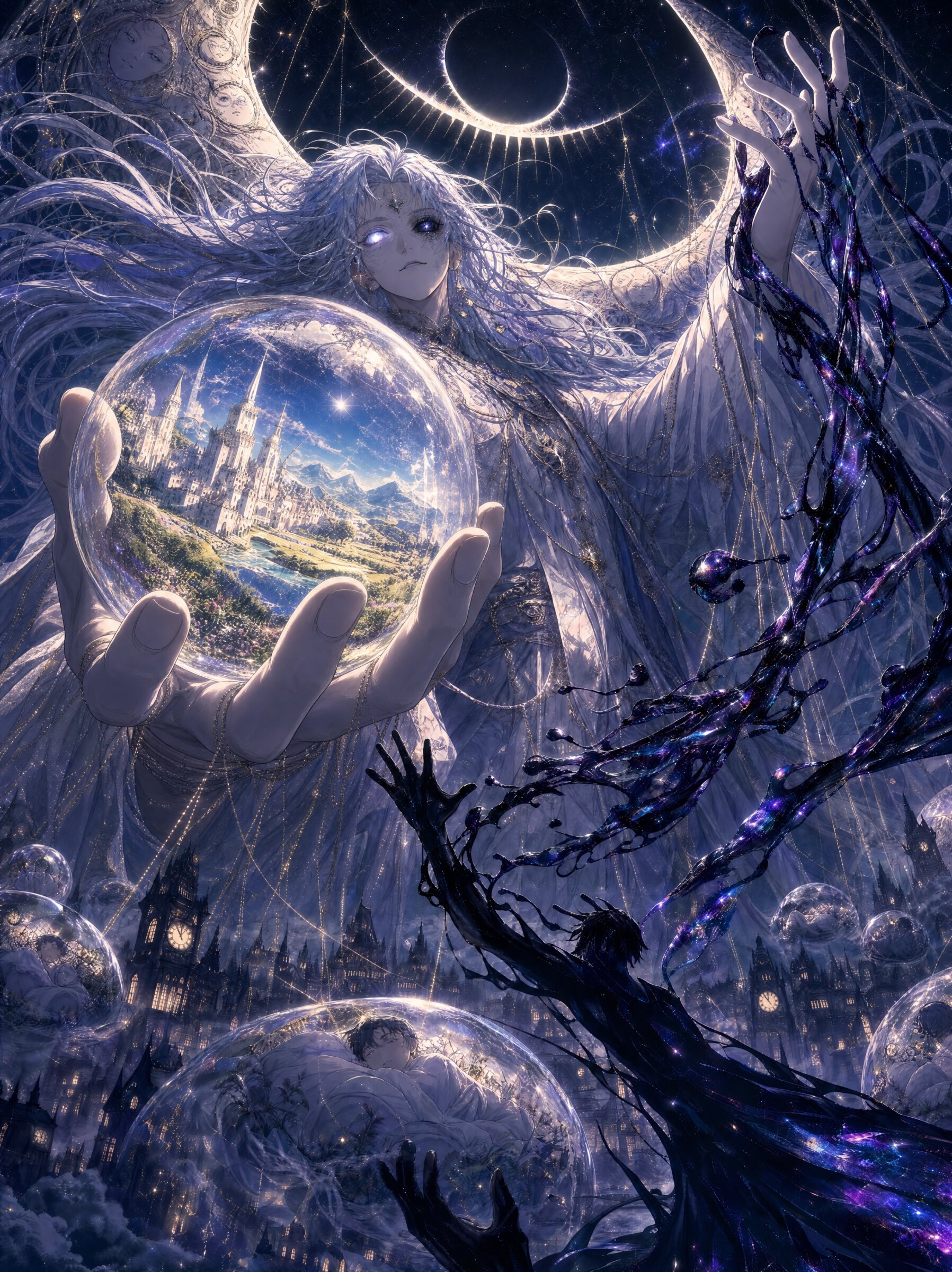

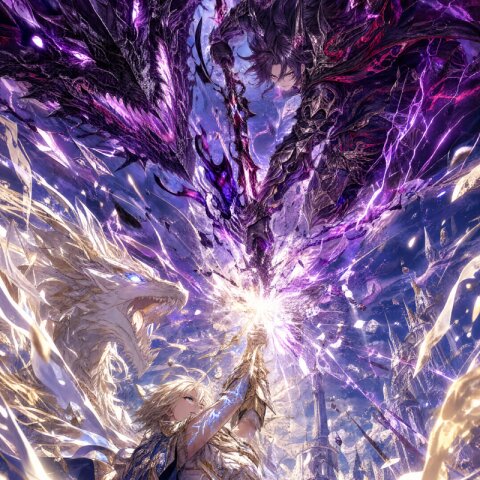
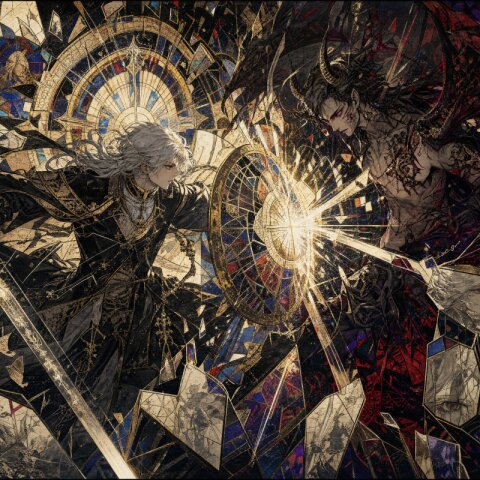
永眠の救済 #godmoon
使用したAI GPT Image 2
年齢制限 全年齢
 いいね
いいね シェア
シェア苦しみのない夢を与えよう。
二度と、目覚めなくてもいいように。
二度と、目覚めなくてもいいように。
プロンプト
Use the uploaded image as a strict visual reference for the same original deity, “The God of Dreams.” Preserve the character’s identity, face, androgynous masculine beauty, silver-white hair, mismatched luminous eyes, pale divine skin, white and silver ceremonial garments, ornate lunar motifs, dream sphere, black iridescent dream liquid, crescent-shaped halo, sleeping city, dream threads, cocoons, awakened shadow, and sacred yet unsettling atmosphere. Preserve the current composition, extreme low-angle camera perspective, character placement, body scale, dramatic forced perspective, lighting, visual flow, dream sphere position, black liquid movement, sleeping city placement, and overall balance of the uploaded image as closely as possible. Do not redesign the entire scene or replace the current composition with a completely different arrangement. The highest correction priority is the anatomical reconstruction of the foreground hand holding the transparent dream sphere. Create a vertical 3:4, premium 4K anime-style dark fantasy illustration. ## Core concept The God of Dreams governs the sleep of all humanity. He removes nightmares and offers perfect dreams, but those blessed by him gradually lose the desire and ability to awaken. The image must communicate: “A god who saves humanity from every painful reality by never allowing them to wake again.” The scene should feel simultaneously divine, beautiful, compassionate, hypnotic, oppressive, and quietly terrifying. ## Main composition Maintain the extreme low-angle perspective from near the surface of the sleeping city, looking sharply upward at the colossal deity. The viewer should feel physically small, as though standing inside the dream world directly beneath him. Preserve the strong asymmetrical arrangement, exaggerated perspective, extreme depth, diagonal movement, and cinematic scale of the uploaded image. Keep the god’s face in the upper-central area, slightly off-center. Show the deity from approximately the lower torso upward, while allowing parts of his garments, hair, arms, and halo to extend beyond the frame. His body should appear enormous, as if he is too vast to fit inside the image. Keep the camera very close to the foreground hand and dream sphere, while the god’s face remains visible farther behind. Maintain the existing dramatic forced perspective without distorting the anatomy. ## Foreground hand and dream sphere Preserve the current position, scale, angle, and visual importance of the transparent dream sphere. The god’s foreground hand should continue reaching dramatically toward the viewer. Keep the hand very close to the virtual camera so that it appears significantly larger than the god’s face. Use natural and believable foreshortening. The hand should enter from the lower-left foreground and guide the viewer’s eye diagonally toward the god’s face. The transparent dream sphere must remain large, clear, and visually important. Inside the sphere, preserve the impossibly beautiful dream world containing: warm sunlight, a peaceful white city, green fields, flowers, calm water, distant mountains, welcoming homes, and a perfect blue sky. The dream world should feel seductive and inviting, as though the god is offering it directly to the viewer. The glass surface should realistically reflect and distort the god’s face, moonlight, city lights, and surrounding stars. Completely reconstruct the foreground hand holding the dream sphere with anatomically correct human hand structure. Correct the wrist, palm, thumb base, finger joints, knuckles, and overall grip. The wrist must connect naturally to the palm without twisting, narrowing abruptly, bending unnaturally, or appearing detached. The forearm and wrist must follow a believable anatomical line into the hand. Give the palm realistic thickness and volume, especially around: the thumb mound, the center of the palm, the outer edge beneath the little finger, and the base of each finger. The thumb must emerge naturally from the side of the palm with a clearly defined base joint. The thumb must curve naturally around or beneath the sphere without appearing dislocated, flattened, or merged into the palm. Arrange exactly five fingers in a believable curved grip beneath and around the transparent sphere. The fingers should follow the round surface of the sphere naturally. Use realistic: finger spacing, finger length, joint placement, knuckle structure, bending, foreshortening, contact points, and pressure against the sphere. The palm must visibly support the weight of the sphere. The fingers should not appear as though they are floating beneath it or growing separately from the hand. The index, middle, ring, and little fingers must each connect naturally to the palm. Do not align every finger joint in a perfectly straight row. Create subtle differences in finger depth and curvature to reinforce realistic perspective. The hand must feel elegant and divine, but still anatomically believable. Preserve the dramatic foreground scale while prioritizing natural anatomy over exaggerated distortion. Avoid: extra fingers, missing fingers, merged fingers, duplicated fingers, duplicated joints, broken wrists, flattened palms, dislocated thumbs, distorted knuckles, uneven finger lengths, fingers growing from incorrect positions, impossible bending, or an anatomically impossible grip. ## Face and expression Preserve the same beautiful androgynous young man with a clearly masculine identity, refined features, pale moonlit skin, and divine sculptural presence. His expression must remain completely calm despite the violent movement surrounding him. Give him a faint, compassionate smile, as though he sincerely believes eternal sleep is an act of mercy. This stillness should contrast with the dynamic composition and make him more unsettling. Preserve his two different eyes: one eye glows intensely like a platinum-white full moon, the other is a deep black cosmic void containing stars and faint galaxies. The glowing eye should remain the brightest focal point in the image. The viewer should feel as though the deity is looking directly at them. Do not alter his facial identity, age impression, eye placement, or calm expression. ## Hair and motion Preserve his long silver-white hair sweeping powerfully across the composition. Keep most of the hair flowing dramatically toward one side, as though caught in a strong supernatural current. The hair should continue creating broad diagonal arcs that reinforce the motion of the image. The ends should dissolve into pale blue, violet, iridescent light, mist, stardust, and dream particles. Keep the face clearly visible. Do not shorten the hair or replace its current flowing silhouette. ## Halo and divine scale Preserve the enormous sacred halo combining: a crescent moon, a solar eclipse, a closed eyelid, and an ornate celestial relic. Keep large portions of the halo cropped outside the frame so the deity appears too immense to be contained by the image. The visible surfaces should contain delicate celestial engraving, sleeping faces, closed eyes, lunar phases, fine gold filigree, and constellation patterns. Keep these details elegant and subtle rather than grotesque. Maintain the slight angle of the halo and avoid making it rigidly symmetrical. Do not redesign or remove the halo. ## Second hand and black dream liquid Preserve the position and pose of the god’s other raised hand. Correct its anatomy only when necessary, without changing its overall placement or gesture. The raised hand must also have exactly five natural fingers with believable joints and elegant spacing. Preserve the black iridescent dream liquid twisting diagonally through the image. Do not convert the liquid into a simple straight vertical stream. The liquid should continue resembling: molten night, black ink, oil, liquid glass, and a flowing galaxy. Inside it, preserve subtle cyan, violet, magenta, blue, platinum, and rainbow reflections. The stream should form sharp ribbons, droplets, suspended strands, and elegant splashes without becoming visually messy. It should continue connecting the god’s hand, the sleeping city, and the awakened shadow. ## Sleeping city Preserve the sleeping city in the lower part of the composition. Keep the city visually subordinate to the colossal deity. Show rooftops, towers, clocks, fog, and glowing windows receding sharply into the distance. Maintain strong atmospheric perspective. All visible clock faces should display exactly the same frozen time. The city should feel vast, silent, and completely asleep. Preserve the thin golden dream threads rising diagonally from the windows and sleeping inhabitants toward the god’s fingers, garments, halo, and dream sphere. The threads should look sacred and beautiful, while also resembling puppet strings, restraints, and a divine control system. Use the threads to maintain the existing visual flow. ## Sleeping person and awakened shadow Preserve the large translucent dream cocoon in the lower foreground. Inside it, keep the sleeping human figure resting peacefully under soft moonlight. The sleeping body should appear safe and relaxed. Preserve the awakened shadow emerging from the foreground and stretching violently toward the god. Keep the shadow large, readable, and visually important. The elongated arms and hands should reach upward in desperation. The pose must clearly suggest that the person’s conscious self is trying to escape from the dream. Keep the shadow abstract, elegant, and readable rather than grotesque. Maintain the strong dark diagonal silhouette across the lower area. Correct the shadow hands only when necessary for readability, but preserve their expressive gesture. ## Additional dream cocoons Preserve several smaller transparent cocoons throughout the city and distant clouds. They should contain peacefully sleeping human silhouettes. Use them sparingly to maintain clarity. A few cocoons may remain connected to the halo by dark threads, suggesting that anyone beginning to awaken is pulled back into sleep. Do not overcrowd the composition. ## Visual flow Preserve the current visual path: foreground dream sphere, the god’s glowing lunar eye, the sweeping hair and tilted halo, the black liquid stream, the awakened shadow, the sleeping cocoon, the city and golden dream threads, then back toward the god. Use strong diagonal lines and overlapping depth layers. Avoid flattening the existing depth. Do not replace the composition with a centered or static portrait. ## Lighting Preserve the cinematic and highly controlled lighting. The brightest light should come from the god’s platinum-white eye. Maintain the powerful backlighting from the crescent halo. Use luminous rim light around the face, hair, fingers, shoulders, and flowing garments. The dream sphere should emit warm golden daylight that contrasts strongly against the cold blue-violet night. The golden dream threads should glow softly throughout the city. The black liquid should reflect subtle neon-like cosmic colors. Keep the deepest shadows around the lower foreground, city edges, and awakened shadow. Maintain clear separation between all major elements. ## Costume Preserve the deity’s elaborate white, silver, pearl, pale-blue, and muted-violet ceremonial robes. Maintain restrained gold filigree, jewelry, lunar details, and celestial embroidery. The costume should continue combining: divine priestly robes, ancient lunar regalia, transparent sleeping veils, celestial embroidery, and surreal dream fabric. Preserve the aggressive directional flow of the garments. Allow sections of the sleeves and robes to remain outside the frame. The cloth should gradually dissolve into mist, stars, nebulae, and translucent dream energy. Do not redesign the costume or simplify its divine ornamentation. Do not allow decoration to obscure the face, hands, or main silhouette. ## Style and rendering High-end anime illustration, premium dark fantasy concept art, cinematic light-novel cover quality, refined Japanese fantasy artwork, extremely detailed eyes, delicate linework, smooth professional coloring, complex but controlled lighting, accurate fabric rendering, layered atmospheric depth, highly polished effects, natural anatomy, believable perspective, and clean visual hierarchy. Preserve the overall art style, color palette, rendering quality, facial design, and atmospheric detail of the uploaded image. Prioritize emotional impact and readability at small social-media viewing size. The glowing eye, dream sphere, black liquid, and awakened shadow must remain immediately recognizable even when the image is viewed as a small thumbnail. ## Anatomy requirements Maintain natural human anatomy and believable body structure throughout the image. The shoulders, torso, arms, elbows, wrists, hands, fingers, and joints must connect correctly. Use convincing foreshortening without warping the limbs. Both visible hands must each have exactly five clearly formed fingers. Give the foreground hand the highest anatomical correction priority. Preserve the original character scale and pose while correcting anatomical errors.
ネガティブプロンプト
Avoid: extra fingers, missing fingers, merged fingers, duplicated fingers, broken wrists, duplicated arms, unnaturally long forearms, twisted shoulders, disconnected joints, flat palms, dislocated thumbs, distorted knuckles, distorted facial features, or inconsistent body scale. ## Important restrictions Do not redesign the uploaded composition. Do not significantly change the camera angle. Do not move the dream sphere to a different area. Do not change the character’s identity, face, hairstyle, eye colors, expression, costume, or divine accessories. Do not remove the dream sphere, halo, sleeping city, black liquid, cocoons, golden threads, or awakened shadow. Do not create a static symmetrical portrait. Do not fully fit the halo, hair, sleeves, or deity inside the frame. Do not make the god appear ordinary, cheerful, harmless, aggressive, or openly evil. Do not use ordinary feathered angel wings. Do not use generic Greek god imagery. Do not use generic fantasy king imagery. Do not create: photorealism, live-action appearance, 3D rendering, plastic skin, flat lighting, muddy colors, blurry details, low-resolution textures, excessive visual clutter, explicit gore, exposed organs, grotesque body horror, cheap horror imagery, deformed hands, extra limbs, or duplicated body parts. Do not include text, captions, logos, signatures, watermarks, hashtags, borders, frames, interface elements, or contest information inside the image.
Steps
Scale
Seed
Sampler
Noise
Strength
Scale
Seed
Sampler
Noise
Strength
コメント
送信
 ログイン・会員登録